



The venture capital J Curve, explained
In this guide, you’ll learn about an important concept in venture capital investing called the J Curve.
What is the J Curve?
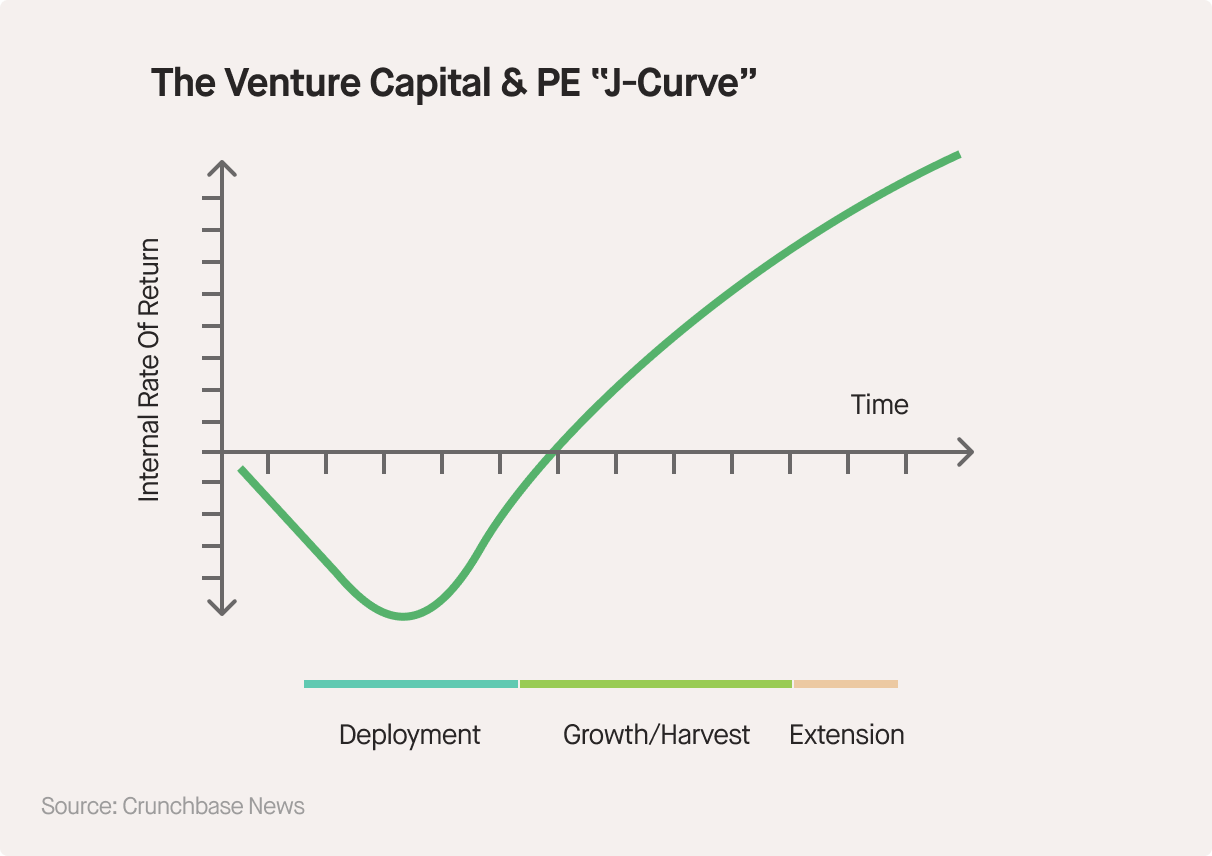
In the first few years of a venture capital fund’s life, fund managers spend their time actively investing your capital into new companies. This period of investment is called a fund’s ‘deployment period’.
During this period, funds invest your money into a variety of companies for you. EIS and SEIS funds will target between 4-12 investments for you, depending on the fund, LP funds will target 20-50+ investments over their lifetime and VCTs will typically have 30-40+ existing investee companies at the point you invest, with more added in the future.
Learn more about EIS, SEIS and VCT funds here
During a fund’s deployment period, it is unlikely that any fund investments will generate returns, simply because the investments have been made so recently and startups take time to grow.
But while companies take time to grow, some companies will start to underperform quickly.
Poor performance can start in many areas: it may be a founding team conflict, the company’s product developing problems that can’t be fixed quickly, or important team members leaving.
As a result of sustained poor performance, some startups will fail. And when they fail, the value of your investment portfolio will begin to drop.
This phenomenon is common in VC (and private equity) investing, and is known as the J Curve. It happens because it takes years for a company to start growing, but a failure can happen at any time.
Future recovery
After a few years, better companies in your portfolio will hopefully grow and offset the losses from earlier, poorer performing companies. At this point, your portfolio will begin to grow again, hopefully to levels significantly above where you invested.
This is why professional venture capital funds invest in multiple companies for you - so you have diversification at the point some companies fail. It also means that, if you see your portfolio reducing in value soon after investment, the J Curve could very well be the cause.
Tax incentives from EIS, SEIS and VCT funds can help mitigate the effects of the J Curve’s negative early years with the rebates available from HMRC, but it is still important to bear this phenomenon in mind as your portfolio rises and falls over time.