



Diversification (and why it is so important)
When investing in venture capital, data shows that the larger your portfolio of startup companies, the more likely you are to generate a positive return on your investment:
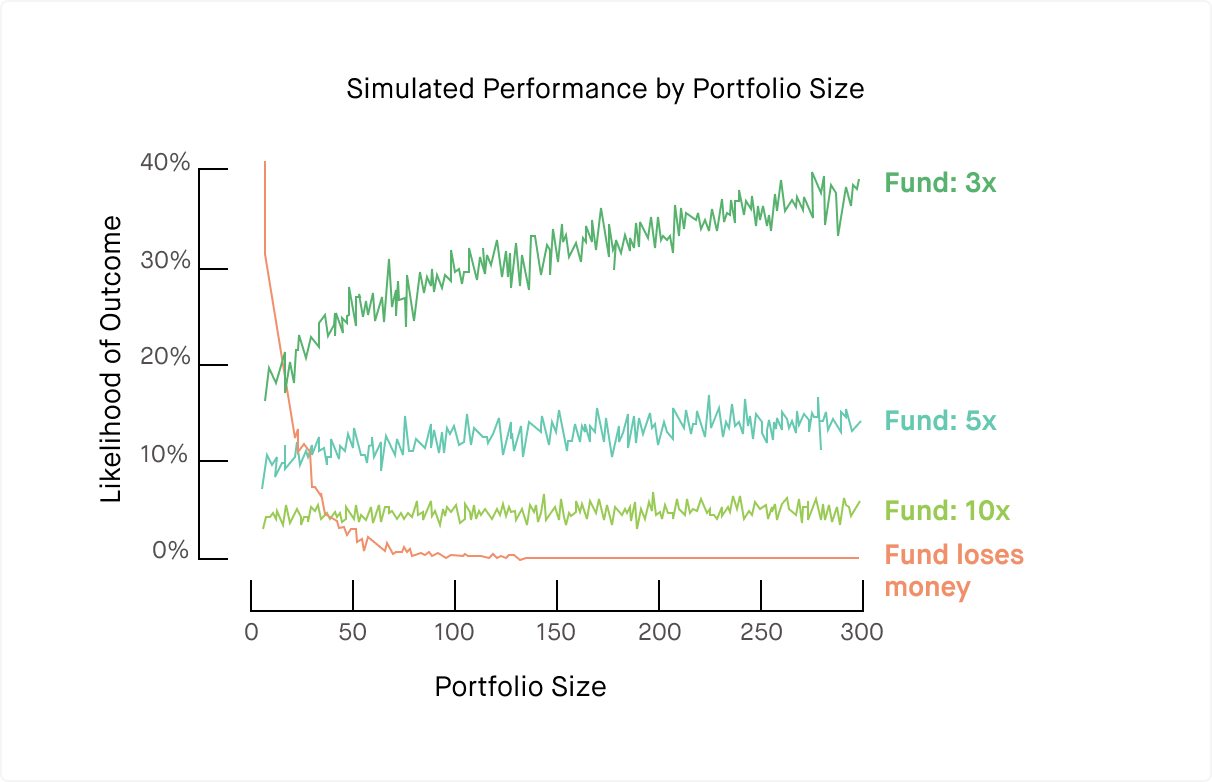
Most people are, however, unable to spend the time required to create a VC portfolio of 50-100 high-quality startups. It is a full time job - and where professional venture capital managers come in.
By investing in multiple venture capital funds through Further, fund managers will fast-track your way to diversification, so you don’t have to devote a significant amount of time to hunting for individual startups to invest in yourself.
For example, by investing across 4 or 5 funds, you can gain exposure to up to 100 young startups, enjoying significant diversification alongside the potential for capital growth and relevant tax benefits.
On Further, the four main types of fund on offer, EIS, SEIS, VCT and LP funds, provide slightly different levels of diversification and returns.
EIS and SEIS diversification
EIS and SEIS funds provide significant capital growth opportunities, and typically invest in 4-12 companies for you each time you invest money with the fund.
EIS and SEIS fund investments also benefit from ‘loss relief’, a tax benefit through which capital losses can be offset against the capital gains or income tax you have to pay in a particular year.
VCT diversification
VCT funds, on the other hand, provide lower capital growth than EIS and SEIS funds, but have bigger portfolios, with 40-80+ companies being common. VCTs often also provide income tax free dividends as a way of returning capital to investors.
EIS, VCT and SEIS: investment and diversification differences
LP fund diversification
LP funds typically invest in 20-50 companies over a fund’s lifetime. Not all funds are similar though - some may invest in as few as 10 companies and others in as many as 100. Each LP fund’s page on Further will make clear the level of diversification the fund is aiming to achieve.
Capital at risk. Past performance is not a guide to future performance. Venture capital investing is illiquid and carries a high risk of total loss. Nothing in this guide is intended or should be construed or taken as investment advice.