



How do I claim VCT relief?

Fiona Cross
fiona@finerva.comThis is a guest post in collaboration with Fiona Cross, Director of Tax Advisory at Finerva, the entrepreneur-focused accountancy firm.
Soon after investing in a VCT fund, you become eligible to claim initial income tax relief on your investment.
- What certificates do you need?
- Apply through Self Assessment
- Online Self Assessment steps
- Paper Self Assessment steps
- Other ways to claim VCT tax relief
- Bear in mind
What certificates do you need?
In order to claim VCT tax relief, you need to receive your VCT tax certificate after investment. This is one of the two documents you will receive after subscribing to a VCT, the other being a VCT share certificate.
If you invested in a VCT, soon after investment your VCT fund manager will either send your VCT tax certificate and VCT share certificate through the post (or, depending on the fund, they will become available for download on the Further investor portal).
You will receive one tax certificate per investment you make in a VCT, and it will be for the amount you invested in the fund at that point.
Once you have received your VCT tax certificate(s), you can claim your relief in the following ways:
Apply through Self Assessment
If you submit your own tax filings each year, known as self assessment, you don't need to send your relevant VCT certificates to HMRC along with your tax return. Instead, you only need to send your certificates to HMRC if they request them.
When completing your tax return, total up the amount across your relevant VCT certificates, and insert the total numbers into the relevant parts of your online tax return in accordance with the instructions below (or ask your accountant).
Online Self Assessment steps
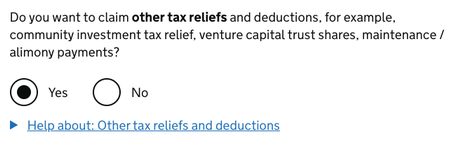
If you use online self-assessment, you need to answer “Yes” to the question on other tax reliefs in section 3, “Tailor your return”:
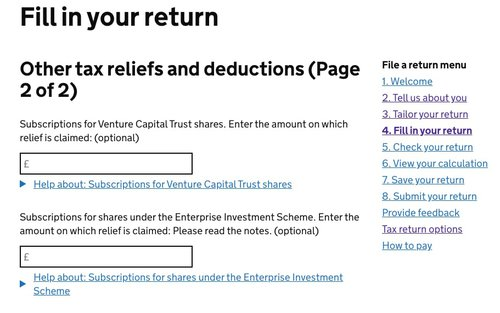
After you have selected “Yes”, in section "Other tax relief and deductions (Page 2)" of section 4 (Fill in your return), you have to enter the total amount of all your VCT subscriptions on which you wish to claim tax relief and can provide details of each of your VCT investments.
If you have any self-assessment queries relating to VCT investing, you can contact HMRC directly. You can find HMRC’s current self-assessment contact details here.
Paper Self Assessment steps
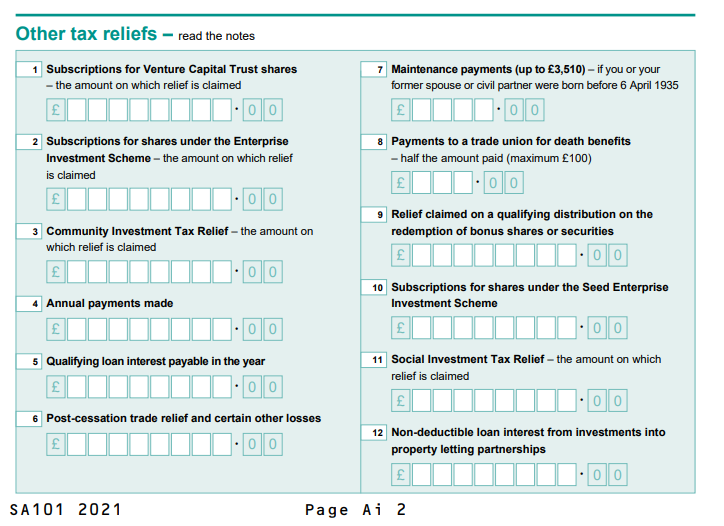
If you use paper self-assessment, you need to complete the “Additional information” sheet (form SA101) and enclose it with your return. In box 1 of the “Other tax reliefs” section, on page Ai 2, please write the total amount of all your VCT subscriptions on which you wish to claim tax relief.
Other ways to claim VCT tax relief
In addition to completing a self-assessment tax return, there are two other ways in which you can claim your VCT tax relief:
Claiming VCT tax relief by writing to HMRC
If you do not complete a tax return, or you invest in a VCT early in a tax year and you pay tax through PAYE, you may claim VCT tax relief by writing to HMRC asking for an adjustment to the tax you pay. You can request a tax code adjustment, so you pay less tax each month, or you can request a tax refund (typically a bank transfer or cheque).
At the date of writing, HMRC’s main office is Pay As You Earn and Self Assessment, HM Revenue and Customs, BX9 1AS.
See a sample letter you can use here
When writing to HMRC, you should include your national insurance number, your latest P60 form and a copy of any applicable VCT tax certificates. If you are in any doubt as to what to do, you can contact HMRC through their current income tax contact details here.
Claiming VCT tax relief if you’re self-employed
If you’re self-employed, you may reduce your HMRC payments on account to reflect the tax relief to which you are entitled. Before doing this, you must be confident that your total tax bill for the tax year will be lower than your payments on account, once you take VCT tax relief into consideration, You can complete form SA303 to reduce your payments.
Remember though, you should only do this if you are confident in your calculations. If you reduce your payments on account below the required level, you will be charged interest.
Bear in mind
When claiming any tax relief, VCT shares must be held for a minimum of five years to benefit from income tax relief. If you sell your shares before the end of this period, you are required to inform HMRC and repay any income tax relief you have claimed on those shares up to that point.
Nothing in this guide is intended to be or should be construed or taken as investment or tax advice. If you are in any doubt as to whether to invest or how investing affects your personal tax circumstances, please seek professional advice.
Fiona is the Director of Tax Advisory at Finerva, the award-winning accountancy firm that specialises in advising entrepreneurs and high growth companies. Fiona has advised on tax matters for over 30 years across a wide range of sectors, from startups to large multinationals. As finalists in the EISA Awards 2022 for Best EIS/SEIS Tax Adviser, Finerva prides themselves on creating business relationships based on trust and working in ways that are refreshingly different to what others might expect from an accountancy firm.