



How do I claim EIS and SEIS relief?

Fiona Cross
fiona@finerva.comThis is a guest post in collaboration with Fiona Cross, Director of Tax Advisory at Finerva, the entrepreneur-focused accountancy firm.
Soon after investing in an EIS or SEIS fund, you become eligible to claim initial income tax relief on your investment.
What certificates do you need?
In order to claim S/EIS tax relief, you first need to receive your EIS or SEIS certificate, known as an EIS3, EIS5 or SEIS3 form.
After you invest in an EIS or SEIS fund, whenever your fund completes an investment your relevant S/EIS3 or EIS5 form will become available for download on the Further investor portal.
See an example EIS certificate and claim form here
In some cases, there may be a delay in receiving your certificate, given companies must have been trading for more than four months, or confirm that they have spent at least 70% of the funds raised, before they can issue these certificates.
With an S/EIS3 form, each S/EIS fund investment will have its own certificate, and each certificate will only be for a portion of your total S/EIS fund investment amount. The only exception to this is an EIS5 form, which is issued once by a fund for all your fund investments. It is much more common, however, for funds to issue multiple S/EIS3s.
Once you have received your S/EIS certificates, you can claim your relief in one of two ways:
Apply through Self Assessment
If you submit your own tax filings each year, known as self assessment, you don't need to send your relevant S/EIS certificates to HMRC along with your tax return. Instead, you only need to send your certificates to HMRC if they request them.
When completing your tax return, total up the amount across your relevant S/EIS certificates certificates, and insert the total numbers into the relevant parts of your online tax return in accordance with the instructions below (or ask your accountant).
Online Self Assessment steps
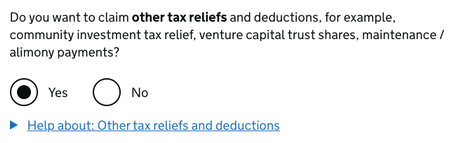
If you use online self-assessment, you need to answer “Yes” to the question on other tax reliefs in section 3, “Tailor your return”:
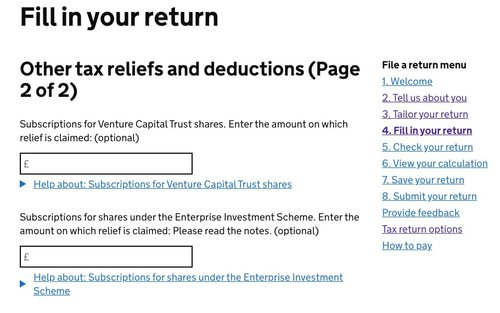
After you have selected “Yes”, in section "Other tax relief and deductions (Page 2)" of section 4 (Fill in your return), you have to enter the total amount of all your S/EIS subscriptions on which you wish to claim tax relief and can provide details of each of your S/EIS investments.
If you have any self-assessment queries relating to EIS or SEIS investing, you can contact HMRC directly. You can find HMRC’s current self-assessment contact details here.
Paper Self Assessment steps
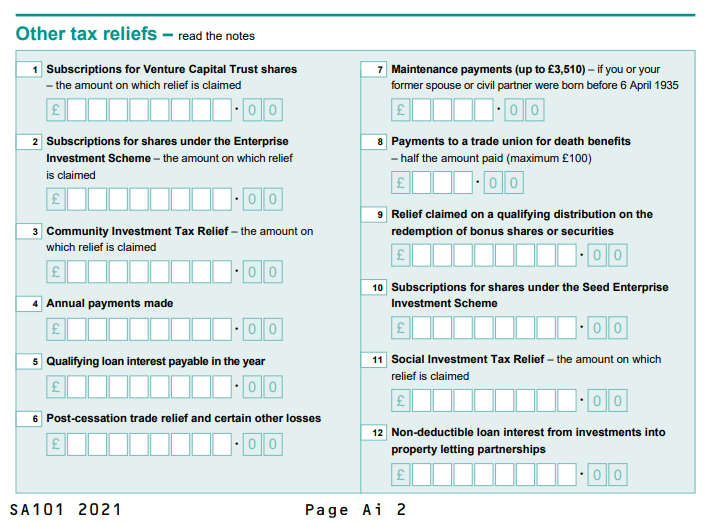
If you use paper self-assessment, you need to complete the “Additional information” sheet (form SA101) and enclose it with your return. In box 2 and box 10 of the “Other tax reliefs” section, on page Ai 2, please write the total amount of all your EIS and SEIS subscriptions on which you wish to claim tax relief.
Apply with your S/EIS Form
If you don't submit your own self-assessment tax filing, you should complete pages 3 and 4 of each S/EIS form you receive and send it to the main HMRC office.
At the date of writing, HMRC’s main office is Pay As You Earn and Self Assessment, HM Revenue and Customs, BX9 1AS.
See an example EIS certificate and claim form here
If you are in any doubt as to what to do with your S/EIS certificate, or how to fill it in, please contact HMRC directly, who will provide you with specific help. You can find HMRC’s current income tax contact details here.
There are some circumstances when you should use your S/EIS3 or EIS5 form even if you complete a self-assessment tax return. These are:
- Carry back relief: if you want to claim tax relief against a previous year, for example where you want to ‘carry back’ your relief to the year before, or if you didn’t receive your EIS3 or EIS5 certificate in time for the tax return deadline in the year the invest was made in.
- Tax code adjustment: if you pay tax via PAYE and want to receive your tax relief through an adjustment to your tax code, for example if you receive your S/EIS3 certificate early in a tax year. You will also have to enter details of the claim when you file your tax return.
- Capital gains deferral: if you want to claim capital gains tax deferral relief as well as income tax relief.
Self-assessment only: Loss relief
Loss relief can only be claimed through the HMRC self-assessment process, because there is no special form for claiming S/EIS share loss relief. If you complete a paper self-assessment, you must use form SA108 to notify HMRC about your loss.
If you do not complete the self-assessment process and wish to claim loss relief, please contact HMRC for further advice. HMRC’s current income tax contact details can be found here and self-assessment contact details here.
When you complete a self-assessment tax return, you can claim S/EIS losses against either income tax or capital gains tax (whichever you would prefer). In your claim, you should specify the source of the loss, the tax year of the loss and the tax year or years to which the loss should be applied. You must make the claim within one year of the 31st January following the end of the tax year in which the loss occurred. For example, for a loss which occurred in the 2021/2022 tax year, you would need to make your claim by 31st January 2024.
Share Loss Relief claimed through self-assessment can reduce the amount of tax that you are liable to pay in that tax year. If that is the case, and you have already paid too much income tax, you can request that HMRC refund the difference straight into your bank account (or by cheque) by completing the relevant section of the Self Assessment form.
Other points to bear in mind
When claiming any tax relief, there are three main points to remember:
- Termination Date: SEIS or EIS shares must be held for a minimum of three years to benefit from income tax relief. Your S/EIS certificate will state the termination date until which you must retain your S/EIS shares. If you sell your shares before the end of these periods, you are required to inform HMRC and repay any income tax relief you have claimed on those shares up to that point.
- Investor Tax Reference: If claiming tax relief through your S/EIS form, you will be asked for your investor tax reference. Not all investors have an investor tax reference number. If you do not know yours, please provide your National Insurance Number instead, to allow HMRC to link your claim for tax relief to your income tax.
- Carrying S/EIS tax relief back a year: when you make an S/EIS tax relief claim, you may backdate your claim to the previous tax year. This is called a 'carry back', and allows all or part of the cost of shares acquired in one tax year to be treated as if the shares had been acquired in the preceding tax year. Income tax relief is then given against the income tax liability of the preceding year, rather than against the tax year in which those shares were acquired. For more information about carrying back income tax relief, read about the key tax benefits of EIS here and SEIS here.
Nothing in this guide is intended to be or should be construed or taken as investment or tax advice. If you are in any doubt as to whether to invest or how investing affects your personal tax circumstances, please seek professional advice.
Fiona is the Director of Tax Advisory at Finerva, the award-winning accountancy firm that specialises in advising entrepreneurs and high growth companies. Fiona has advised on tax matters for over 30 years across a wide range of sectors, from startups to large multinationals. As finalists in the EISA Awards 2022 for Best EIS/SEIS Tax Adviser, Finerva prides themselves on creating business relationships based on trust and working in ways that are refreshingly different to what others might expect from an accountancy firm.